
I’ve mentioned issues with websites on more than occasion in the past.
In some instances the issues have been mildly irritating, whereas in others they have been horrendous.
When an ecommerce website basically tells me / my browser to “get lost” because I’m not using Javascript I get rather annoyed.
However, for every website that tells users (and their browsers) to go elsewhere there’s another that is sitting there welcoming them all in as potential sales.
In the case of Irish handmade chocolates this is really obvious.
A quick search on Google for “irish handmade chocolates” shows the top three or four companies in the sector:
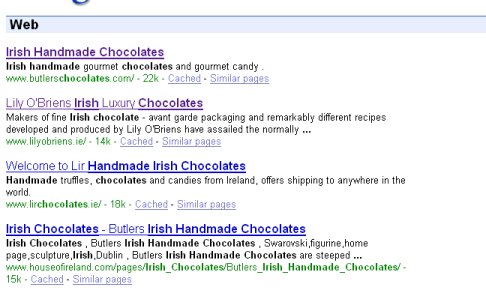
So the 3 main competitors are:
I happen to like chocolate, so the results don’t really surprise me 🙂
Anyway, you could expect the search results to oscillate for certain key phrases.
In this particular sampling, however, there is one wildcard – Lily O’Brien’s. They’re the wildcard for two reasons:
- They just got a complete redesign which changed ALL the URLs
- Their site is completely inaccessible to many browsers (and potential clients/customers)
I should be able to access an ecommerce website using ANY browser I choose.
I don’t expect it to work perfectly in ANY browser, though I would expect it to be functional in the most commonly used ones.
I don’t think that asking that is too much 🙂
Since I like web standards and the like let’s try a little test on all three sites and see what happens:
Butler’s
W3C Validator Test:
The HTML on this site is anything but valid, however once you force the w3c validator to deal with it you get a massive 92 errors!
The silly thing is that most of the errors could be fixed very easily. They’re silly things like missing mimetype declarations for Javascript etc.,
Lynx Test:
The site is usable. Better use of ALT tags would make it a hell of a lot easier to get around, but it does display.
Lily O Brien’s
W3C Validator Test:
Failed.
Now this is the bit that really got me.
Not only did the site fail the test, but it’s actually using server-side UserAgent detection AND is basically telling a large number of browsers to “get lost”.
What’s laughable is that even the “get lost we don’t like your browser page” doesn’t even validate!! How on earth could they put together an error page that doesn’t even work properly?
No DocType declaration and incorrect HTML markup.
Talk about adding insult to injury!
Funnily enough the site currently has a good Google PageRank – I’d expect that won’t last, as the new site is going to be really hard to traverse with a spider.
Lynx: It won’t let me view the site!
Lir
W3C test:
Gives 67 errors. As usual most of them are very simple to fix
Lynx: Navigable.
Not as much content as on the Butler’s site, but it’s still usable
The problem that sites such as Lily’s face is that they are basically trying to force people into using what the developers / designers think people should be using.
What if I wanted to access those sites using a PDA or my mobile phone?
What if I want to use a new funky browser with a UserAgent string that their code doesn’t recognise?
What if I was using a screen reader? While JAWS may support Javascript I’ve already seen issues with UIs on several sites, so a site that doesn’t have any text (or very little of it) is going to put people off.
What about older people with weak eyesite? My grandfather, for example, is over 90 years old. His eyes aren’t good. He has to use onscreen magnification to view a lot of sites. If they’re using more images than anything else there isn’t much for him to see.
What if I have money in my pocket and I need to buy chocolates for my girlfriend? Are you going to tell me to go elsewhere simply because you didn’t code the site properly?
It will be interesting to see how the three sites compare in a few months time when Google has done another dance.
Unless Lilly’s make some significant changes to their current website layout I would predict that they will be severely penalised by Google et al and that their online sales will suffer as a result






Hey,
Nice reading material.
I never read anything from top to end, I usually scan paragraphs, but this one had to red word by word.
How long did it take you to do this?
Now if any of the developers reads this I hope they won’t take it as an insult, this should be taken as a good advice from somebody that eats, sleep and dreams internet.
Nice one
Louie
Thanks 🙂
I tend to multi-task, so I may have started the post last night, but I also did a load of other things while writing it.
You may feel that my post is good advice, but I usually get crank calls from upset developers !
Michele
My grandad use to say:
“Say it as it is. If they can’t take it, is not your fault. Sooner or later they might Thank you for it if there is a bit of decency in them.”
Myself, a comment like this will get me of my a** and strat looking at a way to sort it out.
I don’t like lies and exaggerations. The true hurts but is the true.
I wouldn’t expect any calls from http://www.magico.ie
Phones are complicated devices.
I wouldn’t expect any calls from http://www.magico.ie
Phones are complicated devices.
My own take on the matter – at least Magico are improving in some areas. Their designs are moving from utterly, utterly appalling in recent years to slowly becoming half-way decent. They’re also at the very least making an attempt to implement Web standards – albeit a very poor attempt (completely defeating the purpose actually, but I’m confident that they’ve moved from table-based layouts for a reason and that they’ll learn how to do it properly sooner or later)
Magico won ‘Web Design Agency of the Year’ in the Golden Spider Awards two years ago and were shortlisted last year. It absolutely defies belief that a company that produces such irresponsible product for its clients can receive accolades for such incompetence. According to the press they acquired hundreds of thousands of euros worth of business last year. Why aren’t they hiring front-end and Web standards experts and experienced interface designers? Where is all the profit going to I’d like to know? It’s amazing as much as it is depressing just how easy it is to successfully sucker clients and blag your way in this industry.
I’m glad Magico are making some kind of effort but they have a LONG way to go. Here’s hoping they take some advice from their peers on board and go there quickly. I don’t know… maybe sack one of their over-priced Project Managers or Marketing staff and double their budget for design and tech talent, maybe?
Michele, feel free to delete this if it borders on litigious.
Buying chocolates for ‘a girlfriend’ – bit late for Valentines!! Have you some news to tell me on the ‘amour’ front??
Elly
If I had something to tell you about my love life I wouldn’t do it on my blog 🙂
In any case I was merely giving an example and as it is Valentine’s day I’m sure there are plenty of people still shopping for belated / last minute gifts
Michele
Ken
As designer of the original Lilys site I was given access to the new one a couple of months ago. Standards were non-existent. No doctype, no attempt at any sort of compliance.
I informed Lilys, and suggested they request compliance. The site launch was heavily delayed as a result. And they still didn’t get it right.
“They’re also at the very least making an attempt to implement Web standards”
No. In fact they are only attempting, because it was explicitly requested bt the client.
I just wanted to make this point in case you were worried that Magico were deviating from their old standards……
Sorry Ken, but that is nonsense. What you saw was probably a graphic design only. The web site absolutely DOES comply with W3C standards as you can see here —
http://validator.w3.org/check?uri=http%3A%2F%2Fwww.lilyobriens.ie%2F&charset=%28detect+automatically%29&doctype=Inline&ss=1&outline=1&No200=1&verbose=1
We were not originally allowing the validator to view the site – this is why the error were display, but this has now been changed and you’re welcome to validate away!
In fact ALL of our websites done in the last year are completely XHTML compliant. And we do take the extra steps to do AAA compliance when required – generally by government sites. Although this does limit the design considerably.
Ken, I’m sorry but you don’t have a clue what you’re talking about. The site was not delayed at all at Magico’s end. We were working with Lily’s on re-thinking their business processes while we were at it. At no point were they waiting on us.
Sorry – my comments were directed at Richardo, not Ken.
Sorry – my replies were to Richardo, not Ken.
Russ
Only the main page complies. None of the subpages I just tried pass the w3c validator
Michele
“We were not originally allowing the validator to view the site”
I was using a local validator.
Why would anyone block the w3c validator from a site? It seems like a very odd thing to do.
“Sorry Ken, but that is nonsense. What you saw was probably a graphic design only.”
No, I was looking more at the code than anything else to be honest.
“The web site absolutely DOES comply with W3C standards as you can see here —
http://validator.w3.org/check?uri=http%3A%2F%2Fwww.lilyobriens.ie%2F&charset=%28detect+automatically%29&doctype=Inline&ss=1&outline=1&No200=1&verbose=1
We were not originally allowing the validator to view the site – this is why the error were display, but this has now been changed and you’re welcome to validate away!”
Well I’m glad you’ve decided to tweak the HTML since these posts started going up but I saw it as plain as day yesterday that you didn’t have a Doctype delcared in your markup. You say you somehow blocked the W3C validator initially? May I ask how?
At any rate, I’ve commended the improvement in Magico’s work of late so no need to get too defensive.
“In fact ALL of our websites done in the last year are completely XHTML compliant. And we do take the extra steps to do AAA compliance when required – generally by government sites. Although this does limit the design considerably.”
Making a site XHTML and standards compliant doesn’t really limit the design that much. Albeit preventing you from going nuts with Flash and intrusive technologies. If you know what you’re doing, you can design and very complex, beautiful AND fully accessible website.
Plus there’s a difference between lashing up XHTML that can be tweaked to pass validation tests and actually understanding HTML and semantics properly.
I’d also be very keen to see some of Magico’s AAA compliant sites?
“Ken, I’m sorry but you don’t have a clue what you’re talking about.”
I know, I’m a bit of a div to be honest! *badum tish*
I’m just expressing my opinion and hopefully giving a little advice, mate. Take it or leave it.
“The site was not delayed at all at Magico’s end. We were working with Lily’s on re-thinking their business processes while we were at it. At no point were they waiting on us.”
I never said anything of the sort – I’m sure you’re quite right.
Why would anyone block the w3c validator from a site? It seems like a very odd thing to do.
If there is a good explanation I love to hear it as well.
Ricardo, validation is the least of the problems with the site. Here’s what I get when I visit the site homepage in Konqueror (and by extension, I can see the same thing happening with Safari):
http://talideon.com/downloads/magico/lob01.png
Browser sniffing? In 2007?! WTF?!
Now, let’s visit one of the pages on the site:
http://talideon.com/downloads/magico/lob02.png
Riiight… the site craps out if you view it with the “wrong browser.” Clever. But what happens if I change the user agent string? It’s quite interesting:
http://talideon.com/downloads/magico/lob03.png
and
http://talideon.com/downloads/magico/lob04.png
No problems at all, so what you’re doing is driving away legitimate business from Lily O’Brien’s for no good reason. That seems a rather irresponsible thing to do to a client.
Ricardo, for something like AAA compliance to matter a jot, the site ought to work in any browser, no matter how old and crappy it might be. It might not work well, but it ought to at least function. I see little evidence of that.
Woooaaa there Keith!! I’m not defending the site! I don’t work for Magico [TG]. I’m just the humble developer of the original Lily site [that validated, and worked very well] that Magico have ‘redeveloped’.
Russ is yer man to query.
Sorry about that Ricardo!
🙂 No problem! Just wanted to clear my name [and company].
I think it’s hilarious that Ken is complaining about the design of the new Lily O’Briens webstie.. Has any one viewed the old one… Now that was complete tripe..
Pable – May I introduce to the concept of WHOIS lookups and fixed IPs.
Wonderful bit of technology
Anyone else reading – Pablo happens to be in Magico’s offices, so he’s hardly objective but he is obviously very childish.
“weh weh people are picking on our non-standards compliant site”
“Oh I think I’ll pretend I’m an unbiased 3rd party”
“Yeah – that’ll show ’em”
Michele
Oh I’m aware of it all right.. I just couldn’t wait to get home and post that response.. BTW I never stated I was biased or otherwise. But I still think the old site was tripe..
Maybe it was tripe, but it worked in all browsers, and it worked whether javascript was enabled or not.
Just have to stick in my 2C… If any of you want to test your site for usability or accessibility give me a shout. I can run it through its paces from the perspective of a blind web user depending on Screen reader access. In return all I ask is that you answer a few development / design related questions from time to time.
Pablo, if you’re going to call someone else’s site tripe, at least declare your affiliations first.
Personally I prefer Richard’s original site. One of the main things going for it is that it’s a lot easier to buy stuff. There is an “add to basket” link underneath each item, and it’s immediately clear at the top right what’s in your basket.
With the new version, you click first on “View Details” and then get the option to add to the basket. You then only get the number of items in your basket at the top.
It’s only a small thing, but surely on a site like Lily O’Briens you want as little obstacles to buying the chocolate as possible 🙂
At the end of the day, I don’t think anyone’s going to benefit here by slating each other. It’s more important to come away from this with a little education than it is to leave with bitter tastes in our mouths.
To be honest Pablo, the quality of Magico’s work over the years has been fairly poor – to put it mildly. Both from a creative as well as a technical perspective (technical on the client-side; I’ll assume the back-ends are all sound).
I think the quality of Magico’s work just became a bit more of a talking point when you guys were winning industry awards, followed by massive, publicised contracts! And then turning these contracts, and your reputation as industry-leaders, into irresponsibly designed, poorly executed commercial websites.
Now if you were to put this down to sour grapes or jealousy on the part of your detractors, you would be VERY much missing a very important point point. Also, you would more than likely continue to coast along with your blinkers on, producing crappy websites and thiking the world is against you for no reason other than spite. And that wouldn’t do at all!
I’ve produced some pretty ghastly stuff myself over the years but we improve as we learn. I know that sounds really condescending and, well, it’s meant to be. For a company that’s winning Web Agency of the Year awards, Magico should be a shining example to the rest of the industry in Ireland. You guys should be producing beautiful, SEO-friendly, human-friendly, standards-compliant sites implementing best practice for your clients and giving them the best advice. The fact is that you’re not doing that at the moment. So instead of being defensive, why not try to listen to what everyone’s saying? You’ll learn and benefit from it, even if some people are being bitchy.
I would agree 100% with Ken.
While I was responsible for the previous website, my concern now is for Lily O’Briens. I enjoyed an excellent working relationship with them and really wish them well.
Over the last three years of the site, traffic [and trade] increased dramatically, and I would hate to see that lost. While they’re not a client any more, I still feel a strong sense of loyalty to Lilys and would like to feel that their web presence is being passed into good hands.
This is the sole reason for my posting comments here.
Ken
I think Red Cardinal’s critique of the Spiders goes a long way to cover the entire “award winning” debacle:
http://www.redcardinal.ie/webdev/06-11-2006/golden-spiders/
Michele
I concur.
Spot on, Ken.
It seems that they’ve fixed some of the “issues”:
http://www.mneylon.com/blog/archives/2007/02/20/lily-o-briens-followup/